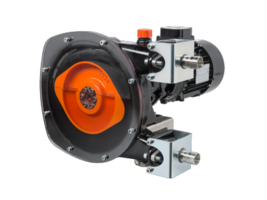

Peristaltic Pumps
Peristaltic pumps are positive-displacement pumps that move liquid by squeezing a flexible hose or tube. They’re widely used for metering, dosing, and transferring difficult fluids—especially where you want accurate flow control, strong chemical isolation, and easy maintenance.
What are peristaltic pumps and how do they work?
Inside the pump, a rotating set of rollers or shoes compresses the hose/tube against the pump housing. This compression pushes the liquid forward. As the hose rebounds after the roller passes, it creates suction that draws more liquid in. Because the fluid stays inside the hose, the pump has strong containment and the wetted path is simple.
Typical applications
• Chemical dosing and transfer: acids/alkalis, hypochlorite, polymers (hose material dependent)
• Water & wastewater: flocculants, sludge conditioning chemicals, sampling and dosing
• Food & beverage / pharma-style duties: hygienic transfer or dosing where a simple wetted path is preferred (application dependent)
• Abrasive or solids-laden fluids: slurries and suspensions (within hose and duty limits)
Why buy peristaltic pumps from Triark?
Triark can support pump selection, spares supply and aftercare—helping you match the pump to your flow, pressure, chemical compatibility, and duty cycle, then keeping uptime high with the right consumables and technical support.
Peristaltic pump spares and service
Common wear/service items include:
• Hose/tube (primary consumable)
• Rollers/shoes and lubricant (design dependent)
• O-rings/gaskets (where applicable)
• Drive components (belts/couplings, depending on model)
Hose Pump Repair and maintenance
Good practice includes:
• Inspect and replace the hose on condition (cracking, swelling, thinning, reduced output)
• Check for leaks and ensure correct clamp/connection integrity
• Confirm duty cycle and backpressure are within limits to extend hose life
• Keep suction/discharge lines supported and avoid excessive vacuum or kinking